
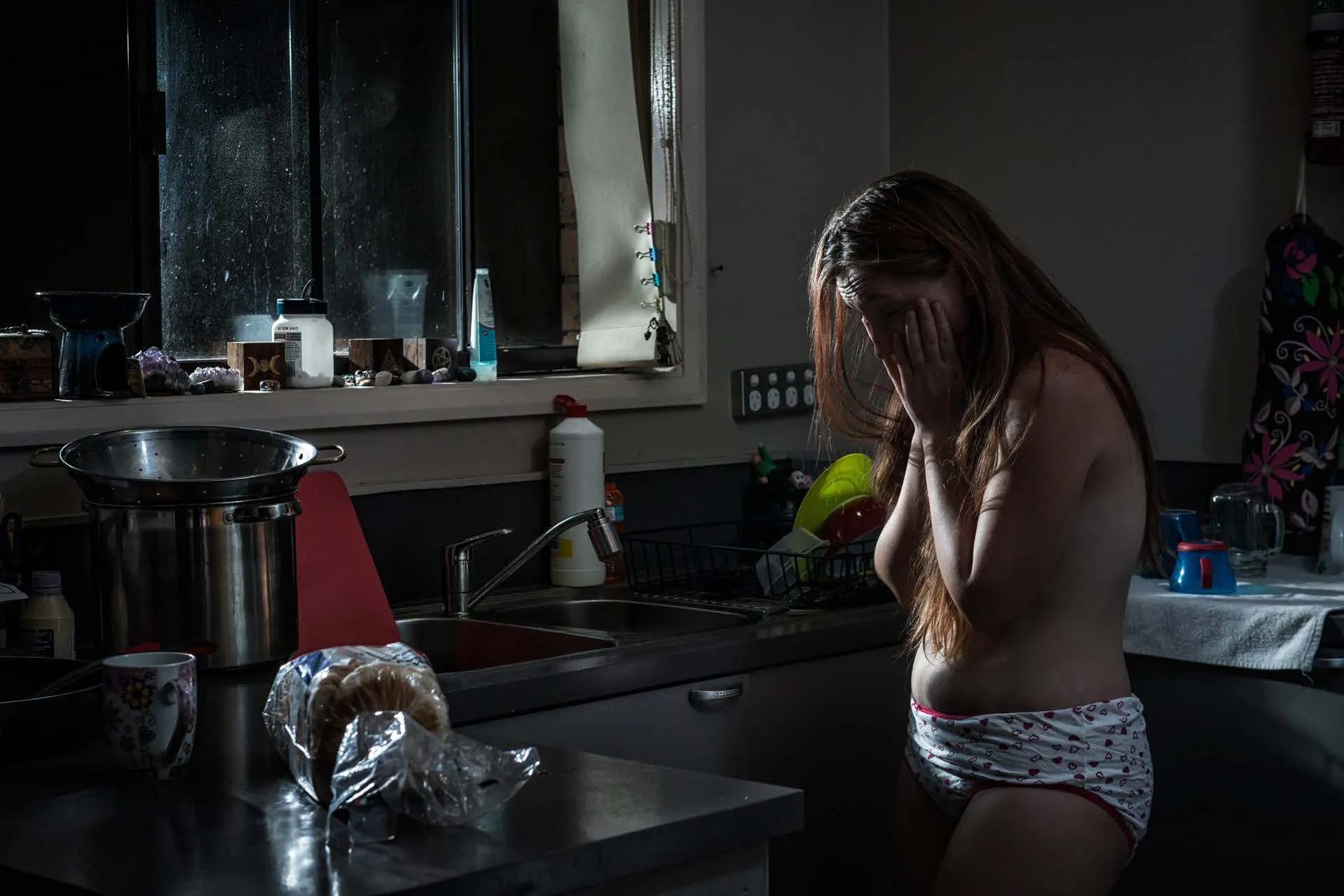
We’ll never know exactly what it is that brought her to such despair, late at night, in the gloomy dark of the kitchen. But we can imagine the broad contours of her anguish because we know our own versions so intimately. She feels that no-one can understand her, that her misery is shameful, that she is utterly alone and beyond sympathy.
What she can’t see, perhaps, but that we might notice in the image, are the small intimations of tenderness: the moonlight lovingly silvers her arms and gently rounded stomach; her underwear is endearingly innocent and child-like; the softness of the table cloth behind her suggests the softness of the words we would, ideally, murmur. We don’t see her, as she sees herself, as a worthless failure. We see her as one of us, as broken, frail, unhappy but deeply in need, and worthy of great compassion and kindness. If only we could, and if only we knew how, we’d want her to feel how much intimate good will we have for her; how her unknown pain moves us.
Our closeness to her in her distress is the great message of the work. At our own lowest ebb, we think no one could ever look at our shame-ridden selves and feel genuinely close to us and powerfully and generously moved. We can’t imagine someone wanting to stand by us, put their arms around us and love us more, not less, because we are so deeply unhappy. We think that our failings, errors, misfortunes and misery cast us out from the human community, which is interested only in our buoyant facade. We suppose that anyone who sees us now – even the people we’re otherwise closest to – would disdain us as weak, incapable fools who deserve our troubles.
And yet, we ourselves have proved the reverse. Our brains may resist the conclusion intellectually, but we know it first hand, right here, in front of this piece of art: in most people, our distress doesn’t provoke contempt, it opens their hearts and brings them, gently and quietly, to our sides.