
One of the characteristic possessions of all European nobles for many centuries was an elaborate depiction of their family tree, showing their lineage down the generations. The idea was that the person sitting at the bottom of the tree would see themselves as the product of – and heir to – all who had come before them.
It can seem like a quaint preoccupation, wholly tied to another age and solely of interest to members of a few grand and ancient families. But the idea of such a tree sits upon a universal and still highly relevant concern: each of us is the recipient of an emotional inheritance, largely unknown to us, yet enormously influential in determining our day-to-day behaviour – normally in rather negative or complex directions. We need to understand the details of our emotional inheritance a little before we have the opportunity to ruin our own and others’ lives by acting upon its often antiquated and troublesome dynamics.
A lot in our inheritance works against our chances of fulfilment and well-being because its logic does not derive from the present; it involves a repetition of behaviour and expectations that were formed and learned in childhood, typically as the best defence we could cobble together in our immaturity in the face of a situation bigger than we were. Unfortunately, it is as if part of our minds has not realised the change in our external circumstances; it insists on re-enacting the original defensive manoeuvre even in front of people or at moments that don’t warrant or reward it.
This is some of what we might have inherited – and how it might be playing out in our adult lives.
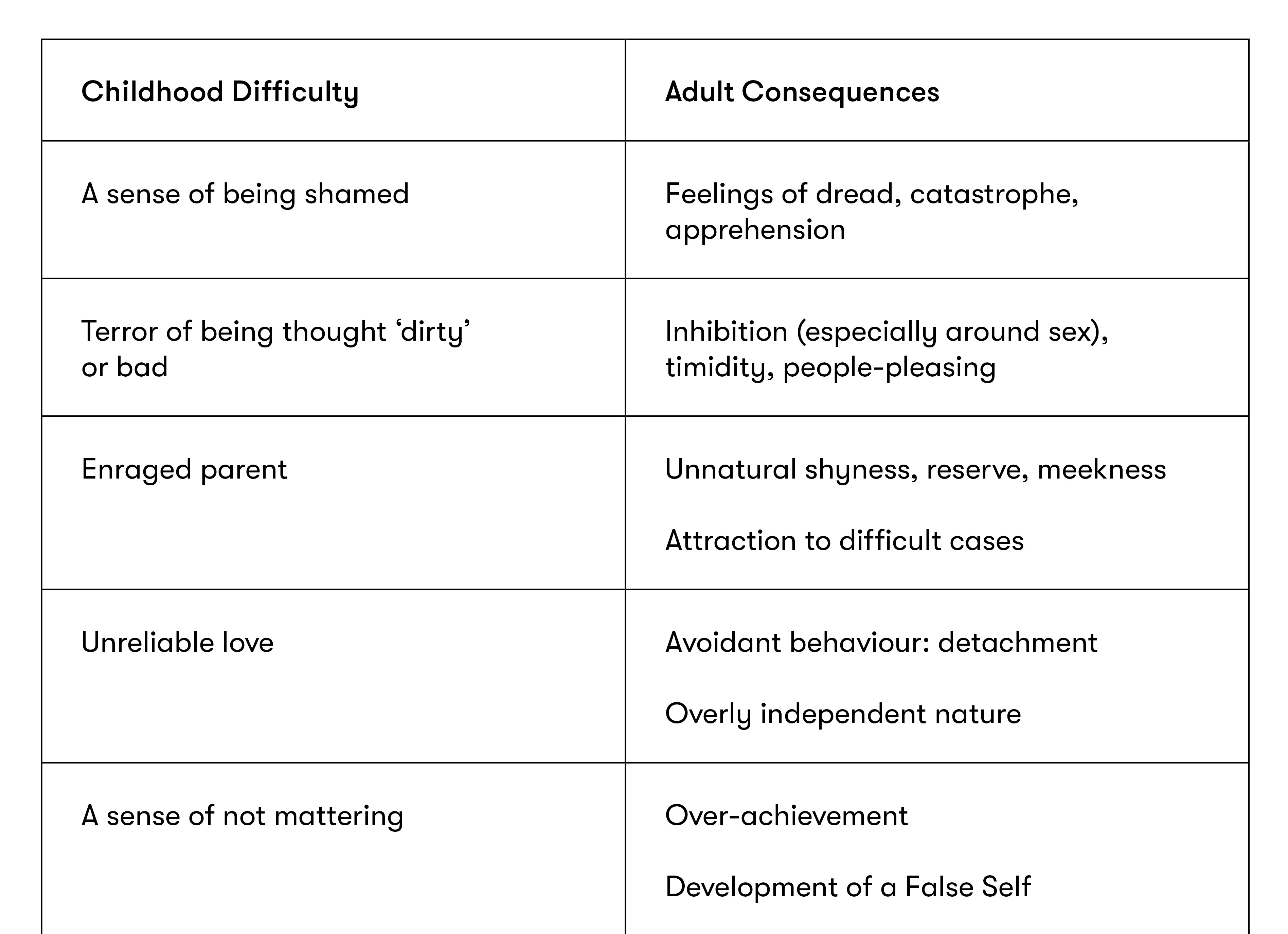
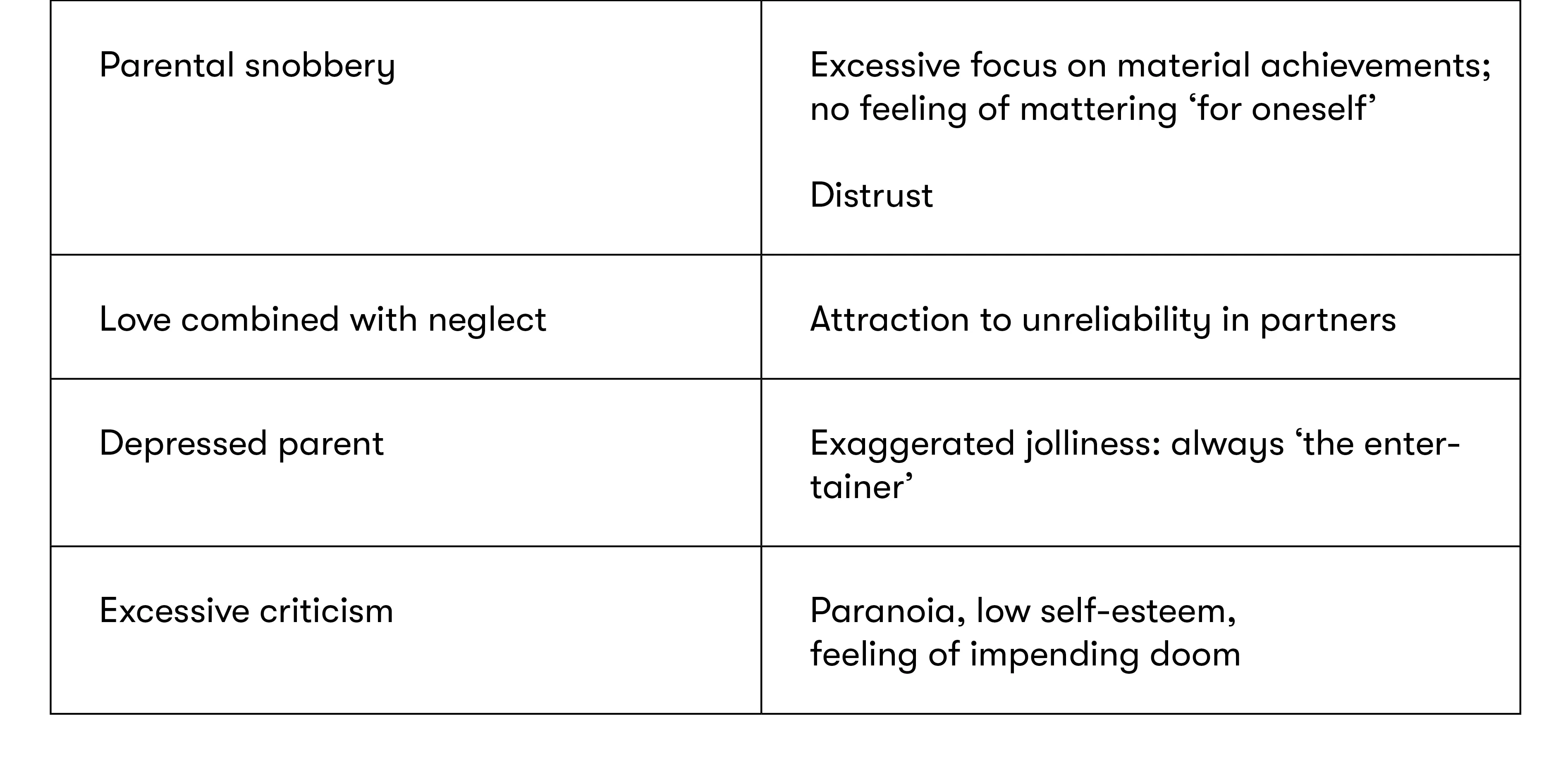
This is – of course – only a beginning. The dictionary of childhood disturbances is a volume almost without end. It should be our responsibility to determine the logic of our own copy, so as to avoid passing down too much of it to the next generation, and of securing a little more calm and trust for ourselves in the years that remain.